Mortgage Renewals in Canada Are About to Hurt — Here’s the Playbook to Protect Your Payment in 2026
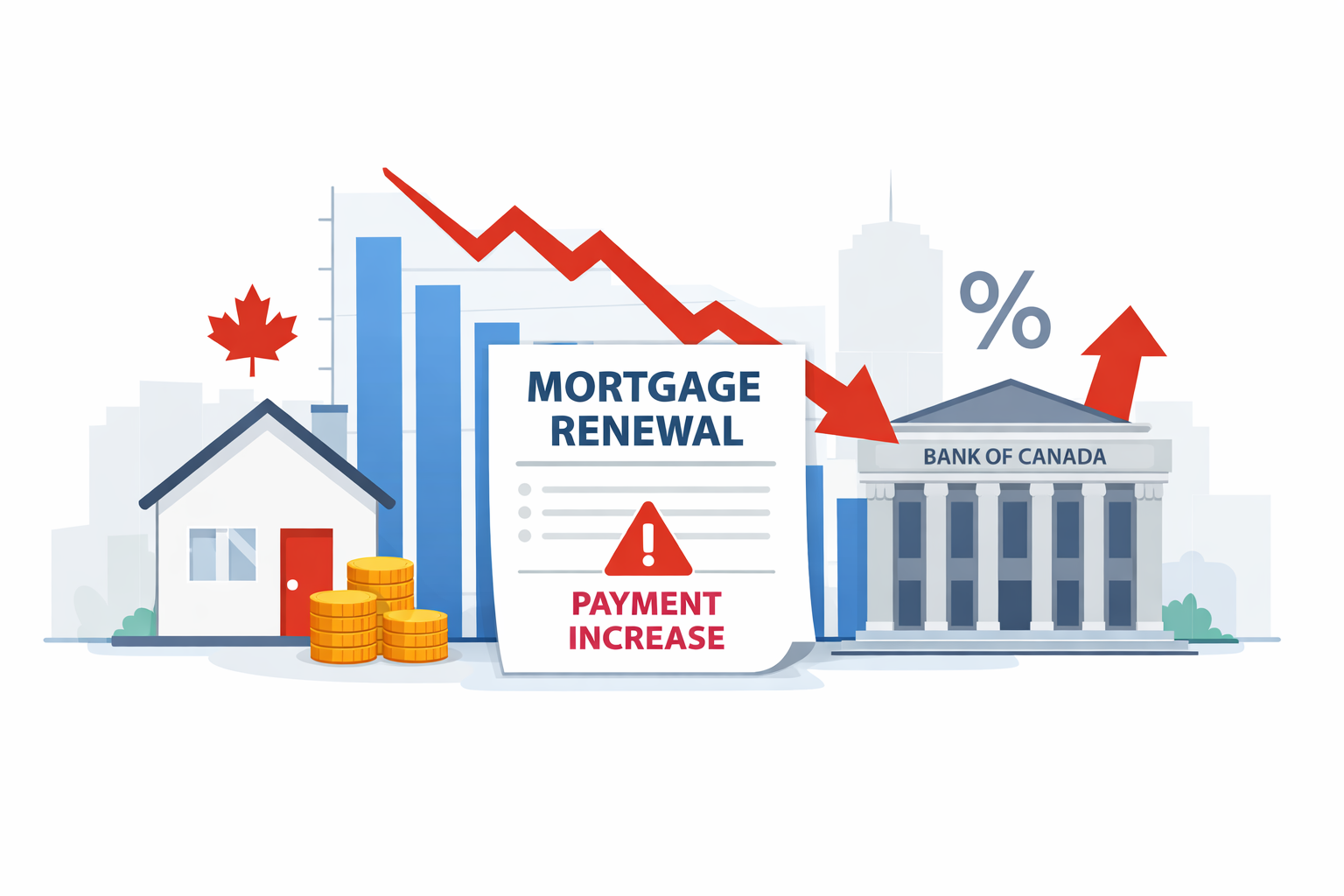
Mortgage Renewals in Canada Are About to Hurt — And Most Homeowners Aren’t Ready
If your mortgage is up for renewal in 2025 or 2026, you may be in for a shock.
Not because rates are “high” — but because your old rate was artificially low.
Millions of Canadians locked in mortgages between 2020–2021 at rates under 2%. As those terms expire, monthly payments are jumping hundreds — sometimes thousands — of dollars overnight.
And here’s the part no one tells you:
👉 Doing nothing is usually the most expensive option.
Why Mortgage Renewals in Canada Are So Risky Right Now
Most homeowners assume renewal is simple:
“The bank will send me an offer — I’ll just sign.”
That’s exactly what banks want.
What’s really happening:
- Payments are recalculated at today’s rates
- Stress-test rules still apply
- Home values have softened in many Ontario markets
- Banks quietly shorten amortizations to protect themselves
The result?
Higher payments, less flexibility, and no negotiation power.
The 3 Options Every Canadian Has at Renewal (Only One Is Smart)
1️⃣ Auto-Renew with Your Bank (Worst Default)
- No shopping
- No leverage
- Often the highest long-term cost
Banks price renewals assuming most people won’t question them.
2️⃣ Switch Lenders at Renewal (Underrated Move)
- Lower rates are often available elsewhere
- Some lenders cover legal and transfer fees
- No penalty at maturity
If your income, credit, and equity still qualify — this is powerful.
3️⃣ Refinance Strategically (Most Flexible)
This is where smart homeowners win.
A refinance can:
- Extend amortization to lower monthly payments
- Consolidate high-interest debt
- Improve cash flow without selling
- Set you up before renewal pressure hits
This works best when done 6–12 months before renewal, not at the last minute.
The 2026 Mortgage Renewal Playbook (Step-by-Step)
✅ Step 1: Start Early (This Is Critical)
Don’t wait for the bank letter.
Start planning 6–12 months before maturity.
✅ Step 2: Get a Real Payment Comparison
You need to see:
- Renew vs switch vs refinance
- Monthly payment difference
- Long-term interest cost
A $300/month difference = $18,000 over 5 years.
✅ Step 3: Stress-Test Your Cash Flow
Ask:
- Can my income support this payment long-term?
- What if rates stay higher longer?
- What if life changes?
Mortgages are about resilience, not just approval.
✅ Step 4: Lock Strategy, Not Panic
The biggest mistakes happen when homeowners rush under pressure.
The best deals go to people who plan — not people who react.
What This Means for Ontario Homeowners (Local Insight)
In markets like Bradford, Barrie, Vaughan, Pickering, and Oshawa, we’re seeing:
- Softer prices than 2021 peaks
- Lenders being stricter on refinances
- Smart borrowers restructuring before renewal
Waiting until maturity removes leverage.
Planning early creates options.
Frequently Asked Questions (SEO Engine)
Will mortgage payments go down in 2026?
Rates may ease, but payments won’t automatically drop unless you restructure.
Should I refinance before renewal?
In many cases, yes — especially if cash flow is tight or debt has grown.
Can I switch lenders without penalties?
Yes, at renewal maturity there is no penalty to switch.
What if my home value dropped?
You may still qualify — but lender selection matters.
🚀 Final Thought
Mortgage renewal is not paperwork.
It’s a financial decision that can save or cost you tens of thousands.
📞 Call to Action (High-Conversion)
If your mortgage renews in 2025 or 2026, don’t guess.
👉 Message me “RENEWAL” and I’ll:
- Compare renew vs switch vs refinance
- Show you the lowest payment options
- Build a plan before the pressure hits
Garry Sidhu
Mortgage Broker — Ontario
🌐 https://www.garrysidhu.ca